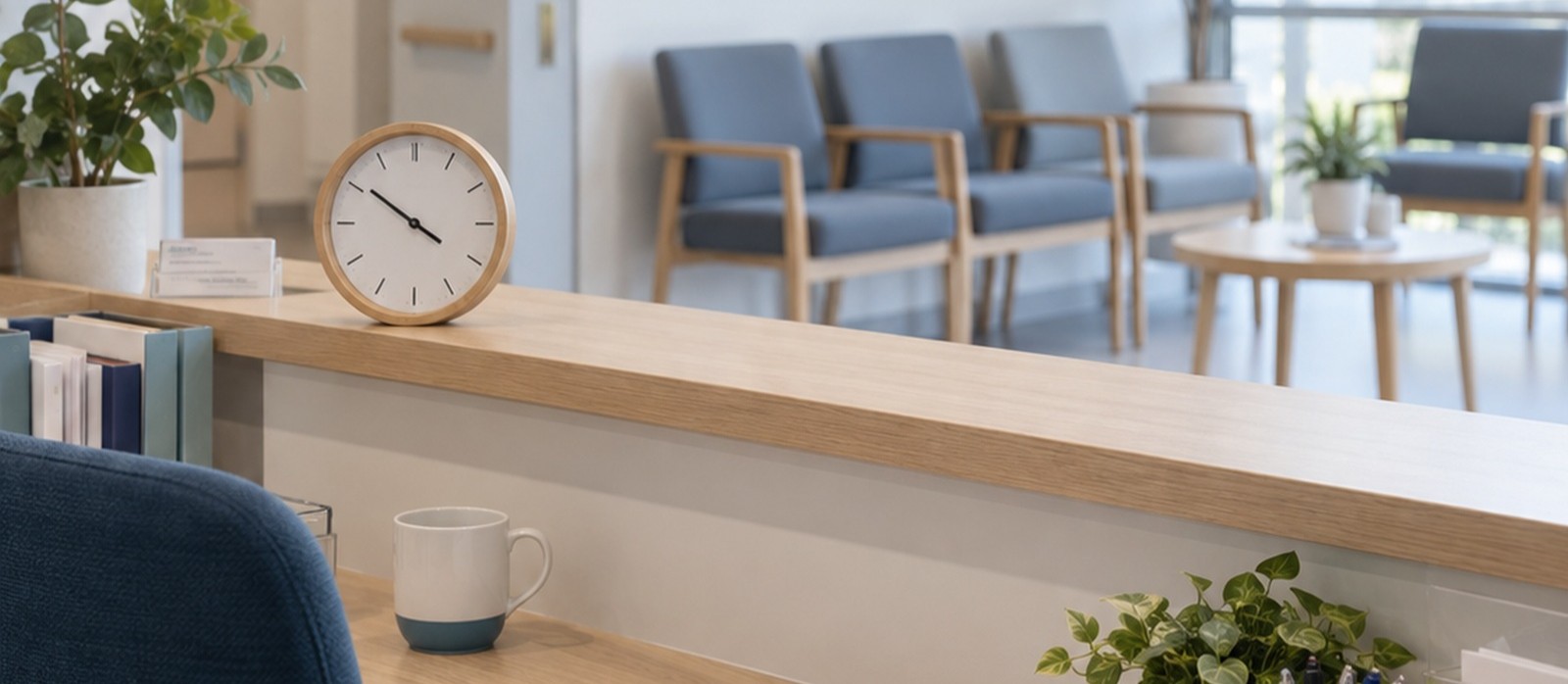
A patient has checked in, found a seat and put their phone away. Their appointment time passes. Each time a door opens, they look up. They are unsure whether the practitioner is running late, whether they missed their name or whether they should ask at reception.
The waiting room may be beautifully finished. Yet this particular moment needs something more specific than a comfortable chair: a dependable way to understand what is happening. For clinic owners planning a fitout, delay communication deserves a place in the brief alongside seating and circulation.
Design cannot prevent every delay, and a room cannot promise how someone will feel. It can, however, make it easier for staff to acknowledge a waiting person and for that person to ask a question without creating a public interruption.
Start after check-in is complete
Arrival planning asks how patients find the entrance and register. Delay planning starts later, when those steps have worked but the expected next event has not happened. Keeping these moments separate helps the team identify the actual problem.
Consider a hypothetical specialist practice where reception faces the entrance while most waiting seats sit around a corner. The arrangement may work well for new arrivals. During a delay, however, seated patients cannot easily tell whether anyone is available to update them. Staff also have to leave their usual position to make contact.
That does not automatically justify moving the counter. It does justify discussing how waiting patients receive information before the joinery and furniture positions are fixed. The response may combine a different sightline, a clearer approach route and an agreed staff routine.
Make asking a question feel ordinary
Imagine leaving a waiting chair to ask about a delay. Does the route take the patient through a line of new arrivals? Must they stand in the entrance? Is there a place to pause without leaning across someone else’s conversation?
A useful layout gives this brief exchange a recognisable place. In a compact practice, that might be a suitable end of the reception counter. Elsewhere, staff may approach the patient. The choice should reflect the real staffing model, available space and privacy needs.
The point is not to create a second reception service by default. It is to avoid making a reasonable question depend on an awkward physical manoeuvre. A patient should not need to appear persistent or unusually confident to discover whom to ask.
Let the update reach the patient
A person may choose a seat away from a busy counter because they prefer a quieter position. That choice should not mean missing information. Review every part of the waiting area, including any overflow position used during busy periods.
Discuss how staff know someone has been updated, who follows up and what happens when the staff member changes. These are operational decisions, but the building can make them easier or harder. A deep alcove may require a deliberate visit; a route crowded with chairs may make that visit inconvenient.
Avoid assuming that calling across the room is the answer. Some information can be general, while an individual conversation may need a more suitable setting. The practice should decide the content and method of communication, with the design team supporting the places needed to carry it out.
Be careful with promises built into the room
A prominent screen or sign can appear to solve uncertainty. Before specifying one, ask who will maintain its information and what patients should understand when the estimate changes. An attractive display with stale information can create a new question instead of resolving the original one.
A clock can help someone keep track of time, but it cannot explain a delay. A screen cannot replace a conversation when the patient needs clarification. These items should support a working communication process rather than become substitutes for it.
Where technology is proposed, review visibility, reach to any controls, glare and how staff will manage it. Do not show names, appointment details or other personal information simply because a display makes that technically possible. Information handling needs its own considered review.
Rehearse a delayed session before approving the layout
A practical design review can use an ordinary scenario: several people are waiting, the practitioner is delayed and reception is also answering a call. Ask the team to describe what happens next, using the proposed furniture plan.
One person takes the patient role and another the staff role. Follow the movement needed to make an update, ask a question and return to the seat. Include someone attending with a companion and someone using a mobility aid when testing the arrangement with appropriate participants and advice.
Record the points where the conversation stops because the space offers no obvious place to stand or sit. Record operating questions separately. A new shelf will not solve unclear responsibility, and a revised procedure will not widen an obstructed route. Both kinds of issue need an owner.
Keep reassurance separate from clinical assessment
A delay update is not an assessment of a person’s health. Staff need to follow the practice’s established process if someone reports a change in their condition or asks for clinical help. The design discussion should not invent that process.
Instead, ask the clinical team what spatial support their approved procedures require. This may affect how staff can approach someone or where a private discussion takes place. Project-specific access, privacy and other requirements should be reviewed by the appropriate advisers.
The distinction protects the purpose of the exercise. The aim is to make communication workable and respectful, without treating a waiting-room concept as evidence of clinical safety, compliance or a guaranteed reduction in anxiety.
Check the arrangement during ordinary use
After opening or making a change, ask staff where delay conversations actually happen. Do patients gather at a place the plan did not anticipate? Do quieter seats receive fewer updates? Does temporary furniture narrow the route back to reception?
Use those observations alongside patient feedback, gathered through the practice’s usual process. Avoid turning an individual comment into a universal claim about what all patients prefer. The useful question is whether this particular arrangement supports the intended way of working.
For the next fitout meeting, bring one delayed-session scenario rather than a general request for a calmer waiting room. Trace how information reaches a person who has already checked in. Trust has a practical setting: a place to ask, a person who can respond and a next step that the team can explain honestly.